Showing posts with label sampler quilts. Show all posts

Monday, February 16, 2015

Just A Sampling

This is not my first quilt.  My first quilt is in a box in the basement.  I'm not sure what I'm keeping it for.  It's made from large scraps from clothes I sewed for myself in the 1970s.  The 100% cotton batting is horribly lumped.  And weirdly, I'm not sure if I can ever throw it out. 
This is my third quilt.  I made another scrap quilt on my own first (pretty bad, but no lumping since I used a blanket for batting) before I sought professional help and took a class at a quilt shop.

As you might be able to tell from the colors, this quilt came from the 1980s.  Peach and brown and green.  The style of the quilt is what we now call a sampler.
This is the book my teacher used--The Sampler Quilt, by Diana Leone, first published in 1980.  I took my class in 1985, but didn't finish the quilt until 1988.  Each week in class we learned a new technique, then we went home and made the block.  We used templates, which we made from plastic or cardboard.  We pieced and quilted by hand.
We did this quilt-as-you-go style, quilting each block separately.  You might be able to see the seam in the pale peach sashing above.  That was the boundary between the blocks.  Each block was surrounded by sashing, layered with a large backing square and poly batting, and quilted by hand.  I enjoyed making the quilt, but I really wanted to make "real" quilts.  You know, the kind where you only use one block pattern.  I decided this would be my last sampler.

And it was, for a while.  About 30 years.

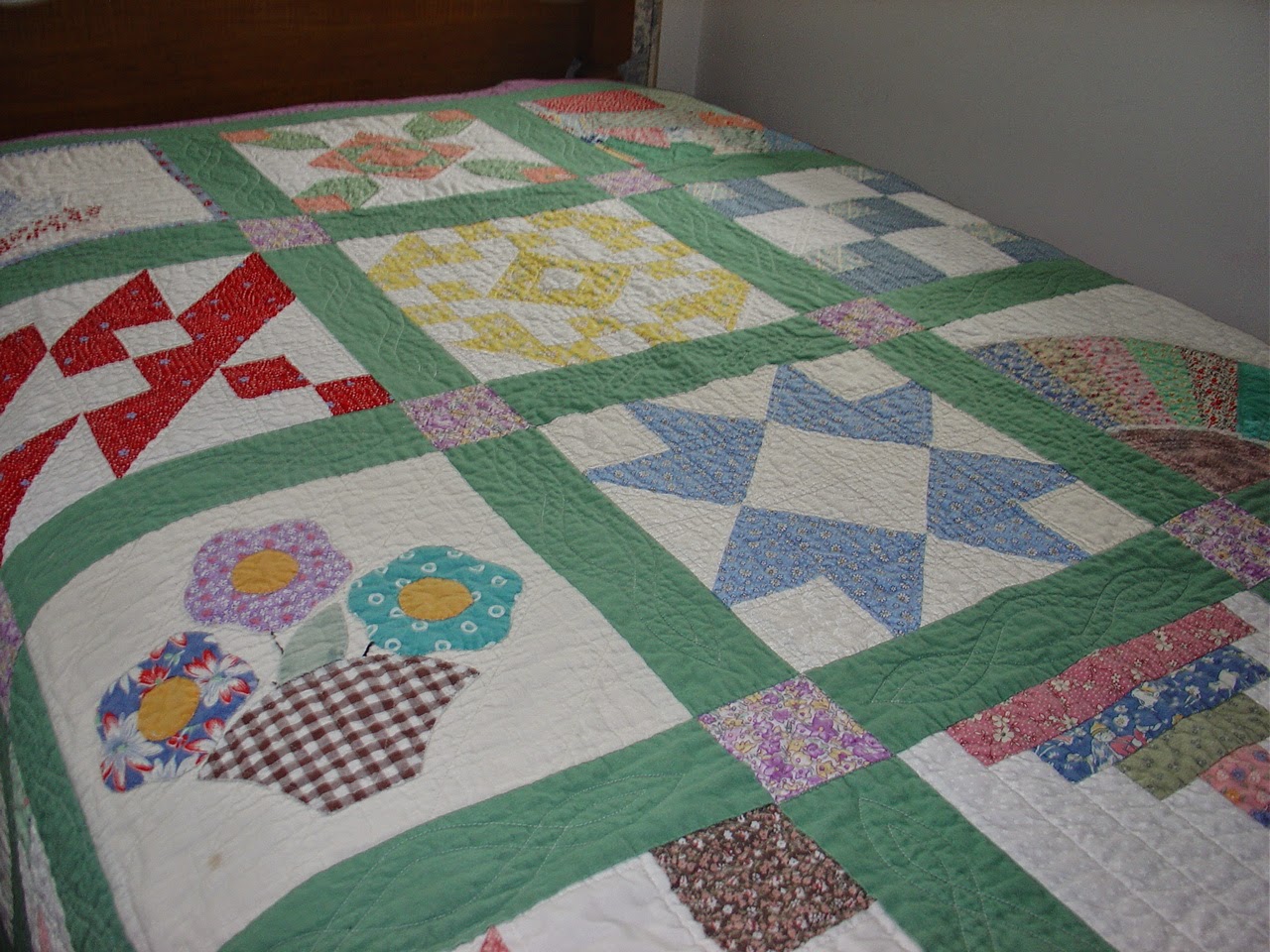
Then I won 25 blocks made from 1930s fabrics at a quilt group meeting.  Well, what else was there to do with them?  I added some actual old blocks from my orphan block pile to make 30 total.
Can you pick out the old block in this photo?  (Hint--it's appliqued.)
I made this quilt with the quilt-as-you-go method, too, but this time I machine quilted the blocks.  It didn't take me 3 years to get it done, either.
Samplers are fun to make, and really are a good learning experience for new quilters.  In my volunteer work with the Wisconsin Museum of Quilts &Fiber Arts, I have seen many, many samplers made in the 1970s and 1980s.  This was the first quilt many people made, their first step into the amazing world of quilting.

In the past, quilts of many patterns were made, but were not necessarily called samplers.  The term sampler comes from embroideries, done to teach a young girl her stitches and sometimes her alphabet at the same time.
According to quilt historian Barbara Brackman's classic book, Clues in the Calico, when the block style became popular in the 1840s, quilts of multiple different blocks began to be made.  In the early years, they were often appliqued album quilts, either made by one person or by a group of friends.  The famous Baltimore Album quilts are of this type.  Later, when applique was less fashionable, friendship quilts were more often made of pieced blocks.  The ones we call samplers were made with many different block patterns by the same person, not by a group of friends.
Many quilt historians believe some quilters kept a collection of various different blocks as a way of remembering the patterns.  The quilter might see a block she liked at a friend's home or a quilt show, and make up a block herself.  She could then keep the block itself as a pattern.  As you can imagine, a person could end up with quite a lot of blocks.  Either the quilter herself, or her heirs after her death, might make these test blocks into a quilt.  This quilt could then be called a "pattern quilt".  Quilts of this type often have blocks of several different sizes.

I found one of these sets of blocks at a flea market several years ago.  

 Stuffed into this lid-less basket were quilt blocks of all types and sizes.

Many of the blocks had slips of paper pinned to them, with the name of the block on them.

This one says "3 Saw Tooth".  I have seen it called Saw Tooth Star before.  Wonder what the 3 is about.

She called this one Devil's Puzil (how's that for phonetic spelling?).
Some of the blocks had templates pinned to them.  This is the back of a square template, made from a 1907 calendar.

Here's the back of another template.  It appears to be a page from a high school commencement program.
This one is from the same source.  It says, "Wealth may seek us.  Wisdom must be sought."  Words to live by.
I don't know if I'll make my antique block collection into a quilt.  Some of the blocks are not in good shape, so couldn't be used.  Some of them are stained, probably from the basket they were stored in.  But it might be fun to put the good blocks together like a "puzil".

It's fun to look for sampler quilts (or any other kind of quilt!) on the Quilt Index.  Here are a couple of antique samplers.


This is Hattie's quilt, and is probably a friendship quilt, so not technically a sampler.  It was made in Nebraska in 1890.
This sampler top was made in the same time period, but in Massachusetts.
Want to see more?  Click on the link, and search for quilts.
Quilt Index

And finally, this is my all time favorite sampler:


Yeah, I've got a weakness for chocolates.  I do like having the map included, so I know which ones I'm getting.
I hope your week ahead is full of quilting fun.


Monday, February 9, 2015

Put A Label On It!


 I sewed this label on last night.  I bought a package of these labels a while back, and they really seem appropriate.  While I don't have a bun in my hair and don't fill up the chair quite as well as this lady, I do admit to the cat and the treadle.
I wish I had labeled more of my quilts.  Sometimes I just write my name and the date on the quilt in permanent ink, but often I don't even do that.  Mostly I can't remember when I made a certain quilt.  A label would really help.
Here's a huge label I made from an old sewing machine advertisement.  I even recorded which machine I used to make the quilt--a Singer model 27 dated 1892.

In my volunteer work with the Wisconsin Museum of Quilts & Fiber Arts, I always make sure to take a photograph of any labels we may be lucky enough to have on documented quilts.  We don't think we'll forget, but we do!  And the next generation will not have any idea.  So label your quilts already!

Okay, I'm down off the soapbox now.

Here's the Reproduction Chain quilt I was working on last week, all done.
The binding is stitched down, now I just have to wash it to get the chalk marks out.  Today I'm doing our regular laundry, so I might get to it tomorrow.

So on to the next project, right?  And the next one for me is my Jane Austen block of the week quilt.

Back in May, I posted about Barbara Brackman's Jane Austen Family Album quilt.  I was only 5 blocks in then.  I've got 30 done now, and I was setting them together this weekend.
Here I've got 4 of the 6 rows laid out on the floor, with sashing and cornerstones.  I had a completely different idea about how I was going to set them, but it didn't pass the audition.
These blocks are very very different.  I didn't use a controlled color palette.  In fact, I used all sorts of different scraps of fabrics I'd been saving for years.  And of course, like any sampler, the block patterns are wildly different.
You can see how different they are.  I had planned a light sashing, but it just couldn't contain the blocks.  By the way, the block in the center is Bright Star, the one Barbara intended to represent Jane Austen herself.
This is one of my favorite blocks.  It's called Friendship, and the center square is a toile with two women talking together.
There were 36 blocks in the series, but I had decided to make only 30 before it even started.  I've never liked square quilts, and 30 seems about the perfect number for 12 in. blocks.
I'm going to quilt it in 3 sections so I can move the quilt around easily while I work.  I think I'll probably want to quilt each block differently.
Making the Jane Austen sampler has been such a learning experience.  Every week Barbara shared interesting facts and visuals from Jane's time period and details about her family and friends.  It was like taking a free class.
Here's a link to my previous post, which has a link to the Jane Austen Family Album block of the week:
Sundays with Jane

I've also been watching all of the movies based on Jane Austen's work--well, most of them.  I'm not really interested in zombies.

This one is my absolute favorite:  The BBC version of Pride and Prejudice, starring Colin Firth as Mr. Darcy.

Mr Darcy & Lizzie (Colin Firth & Jennifer Ehle)

It's an old one, from 1980 or so.  I like it not because I'm a huge fan of Colin Firth (but what's not to like?), but because it is so true to the book, and the character actors are so good.
We're still deep in winter here, but there is a hope of spring, and we know May will be here eventually.  Until then, we've just got to keep warm, and keep sewing.
Happy Quilting!


Monday, May 5, 2014

Sundays with Jane

I have been spending my Sundays with a most congenial companion--the British author Jane Austen.  It started in April, with a block of the week on a site called Austen Family Album, designed by quilt historian Barbara Brackman.
Each week, Barbara writes a short article about something in Jane's life, and accompanies that with an appropriately named quilt block.  The posts appear on Sunday mornings.
This is the first block, for Jane herself.  It's called Bright Star.  I used some really fancy fabrics from my reproduction stash.  This must be what I've been saving them for.

Block #2 is Sister's Choice, for Jane's sister Cassandra, which I've pictured at the top of this page, with a book I borrowed from my eldest daughter.  Here's a detail, showing a woman in the toile background.

Block #3 is for Jane's father, who was a clergyman.  Its name is Cross within Cross, which certainly seems appropriate for a minister.

Block #4 is for Jane's mother, Cassandra Leigh Austen.  It's called Thrifty, and she certainly had to be, with 8 children on a minister's salary.  I used more of the toile in the center, this time with a picture of a house, since her home was the center of Mrs. Austen's life.

Yesterday was the fifth week.  This week's block is called Village Square, for Jane's brother James, who also became a clergyman like his father.  I used some of the same fabrics in this block as in Rev. Austen's block.  The center square is a toile from Judie Rothermel.  I'm using it to represent the church being at the center of James' life, but it's really supposed to be Independence Hall and George Washington.
Because of this wonderful block of the week, I've been reading Jane Austen's novels.  I had sort of read Pride and Prejudice in high school, but I really didn't have the background knowledge to know what was going on, or to appreciate it.  I'm saving it for last, as I read the others.  The library has all the books, and I'm finding I really enjoy them, even to the point of reading when I "should" be sewing.
It's not too late to get in on the fun.  All the instructions are still up.  There will be a total of 36 blocks, and only 5 have been presented so far, so there's plenty of time to catch up.  You can post pictures of your blocks, and see the ones everyone else has done.  Quite a few are being done in modern fabrics, even some really wild and fun stuff.
All of this is totally free!
Here's the link:
Austen Family Album
This will take you to the most recent posts.  To start at the beginning, just click Older Posts at the bottom right of the page.
Happy Quilting!