Showing posts with label string quilting. Show all posts

Sunday, November 9, 2014

String Quilts, Part Two

As promised last time, I'm going to show more of my antique string quilts and blocks in this blog entry.

Isn't this one a hoot?  Instead of string pieced squares or diamonds, these are hexagons.  The fabrics in the hexagons are kind of plain, but who could notice that with all that orange hitting you in the face?  The quilt maker has added a yellow hexagon center to each block, and green triangles to the tips of the hexagons. 

In the close up, you can see the strings better.  You might also notice the machine quilting.  This one dates from the 1950s or so.

Here we have a less successful example.  This is a finished quilt, that I bought in an antique store.  (Sometimes, if the price is right, I have been known to adopt quilts just because I felt sorry for them.)
At first glance, you might be wondering what on earth is going on here.  (I know I was.)

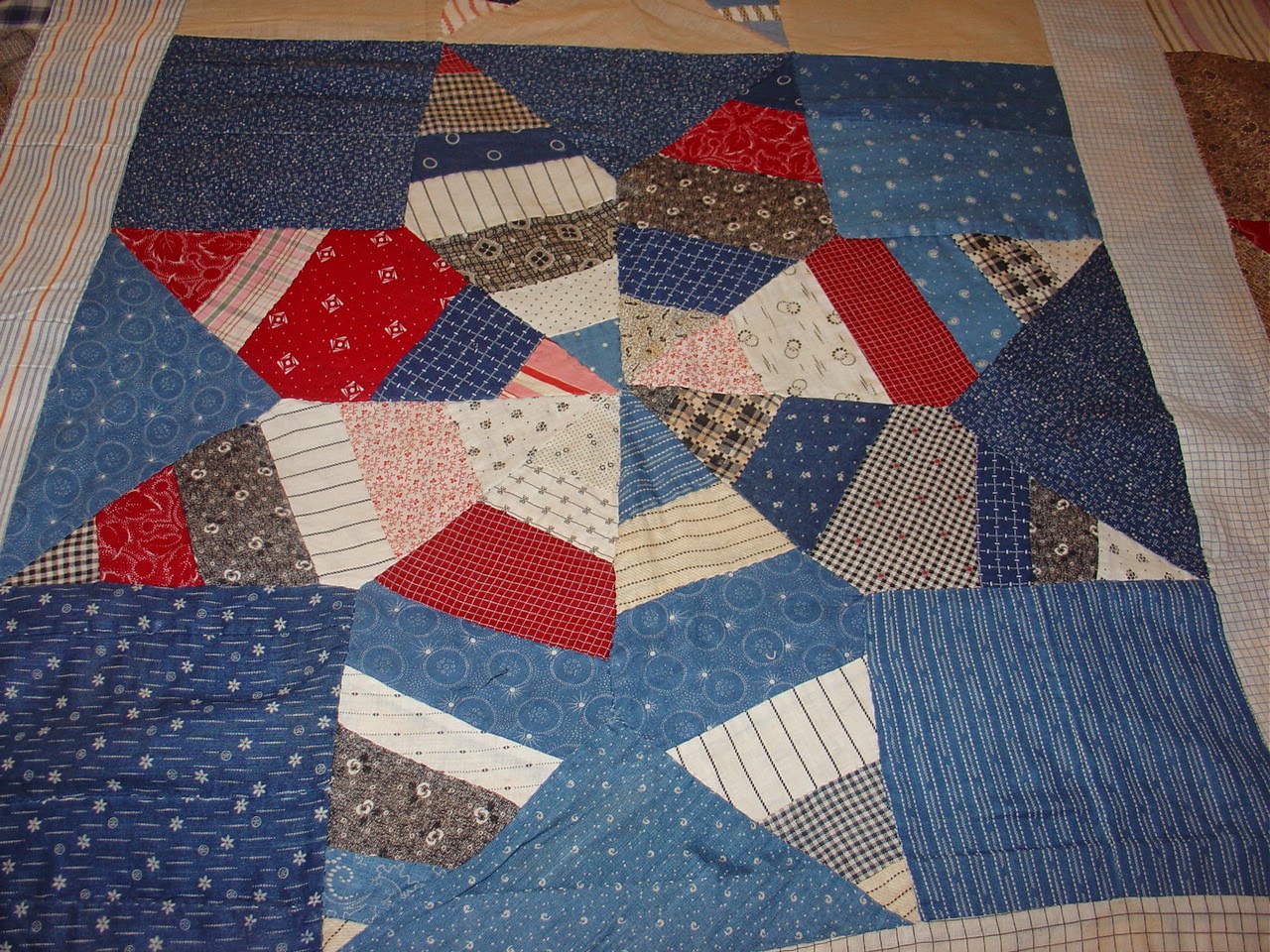
Let's look at an individual block.  Can you see the 8-pointed string star?  It's stretching the definition to call this a string quilt, since the "strings" are so wide.  The maker has also string pieced the corner squares and the side triangles, and even the sashing!  It's a tour de force of recycling, but not a very attractive quilt.


Yet another example.  This one is a six-pointed star.
This quilt maker has string pieced the six center diamonds, the diamonds surrounding them, and the narrow triangles in the corners.  It's a fun collection of fabrics from the 1890s through the 1930s, but not much to look at.

The reason is contrast.  Your quilt teacher was right, contrast is the key to a good design, either in scraps or strings or new fabrics.  Without contrast, the design disappears and it just looks like chaos.

This top is a little better.  These are rectangles instead of squares.  Most of the fabrics are from the turn of the 20th Century, but a few are from the 1930s and 1940s.

Many of these fabrics make my heart go pitty pat.  (Check out the gray print!)  This quilt maker machine top-stitched the strips to each other with black thread.  It's a pretty good quilt, but it could be better (in my opinion) if there was more variety in the fabrics and colors.

Variety is really important in scrap quilts in general and string quilts in particular.  This block is okay, but not nearly as much fun to look at as the blocks in this quilt below (which I showed last week).

Hint:  An easy way to get more variety is to use smaller pieces.
Here's another block in the yellow and green quilt:
This one really suffers for lack of variety.  Nearly every diamond has a big hunk (or two!) of the same blue print.

Another hint--make sure the tips of your diamonds do NOT match the background.  It makes them disappear (contrast again).


One last chaotic top:
These are rectangles, pieced with everything but the kitchen sink.  There are even orphan blocks and pieces!  From the amount of wear, I think it was a tied comforter that has been taken apart.  An Ebay find, this one was made in 1925.

How do I know that?  Take a look:
Embroidered on one block is this inscription:  Lena, From Grandma B. 1925.
Good job, Grandma B, signing and dating your quilt!

One of the things I like about finding string quilt blocks pieced on paper is the possibility of finding a date on the papers.  It doesn't necessarily mean the quilt blocks were made on that date, but they could not have been made before that date.  It gives us a place to start.


Many string quilts have been made in this pattern, often called Rocky Road to Kansas.  These blocks were probably pieced in the 1920s or so.
Their papers were removed before I got them, but you can still see the fragments on the back.

I have a whole set of these blocks, which are made a lot like the ones I'm currently sewing.
On the back is an advertisement for a sale on women's coats.  It says "Sale Closed October 14, 1922".  So if you guessed this block was made in the 1920s, you are correct!

Another one of the blocks advertises fabric for sale.  Yes, that's right, the most expensive fabric on the page cost 38 cents per yard.  It was tougher to get 38 cents then, of course.

String piecing was very popular during the Great Depression, and also during World War II when fabric was harder to get.  These blocks were hand sewn on pieces cut from newspapers.
This pattern is called Baseball or Snowball.  It is usually set with plain white circles (thus the pattern name).


These triangles are some of my favorite string blocks. 
They are pieced on pages from the Sears Roebuck catalog of 1907.
I originally bought all of these block sets with the idea of finishing them into quilts.  It might happen, someday.  If not, I'll pass them on to someone else to enjoy.
Thanks for looking through my collection with me. 
Happy quilting!


Monday, November 3, 2014

How Firm a Foundation--String Quilts on Cloth Squares

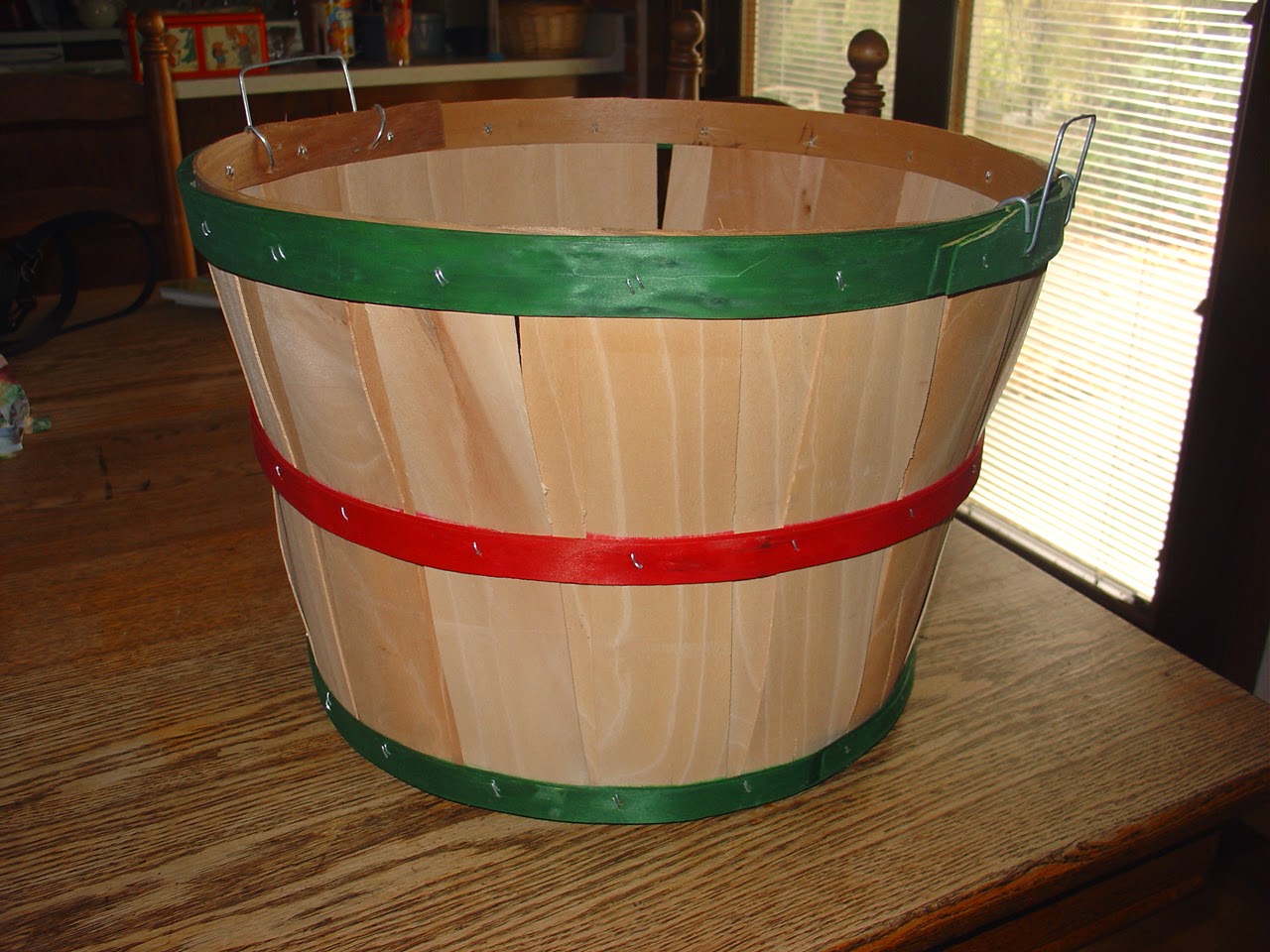
This is a bushel basket.  It had apples in it when we brought it home from the orchard.  You have to pay extra to take the baskets home, but it's not a lot, and they're really useful.

Here's my favorite use for a bushel basket.  This is where the strings end up when I'm sewing--pieces cut from backing, stray triangles, odd shaped pieces, strips less than 1.5 in. wide, etc.

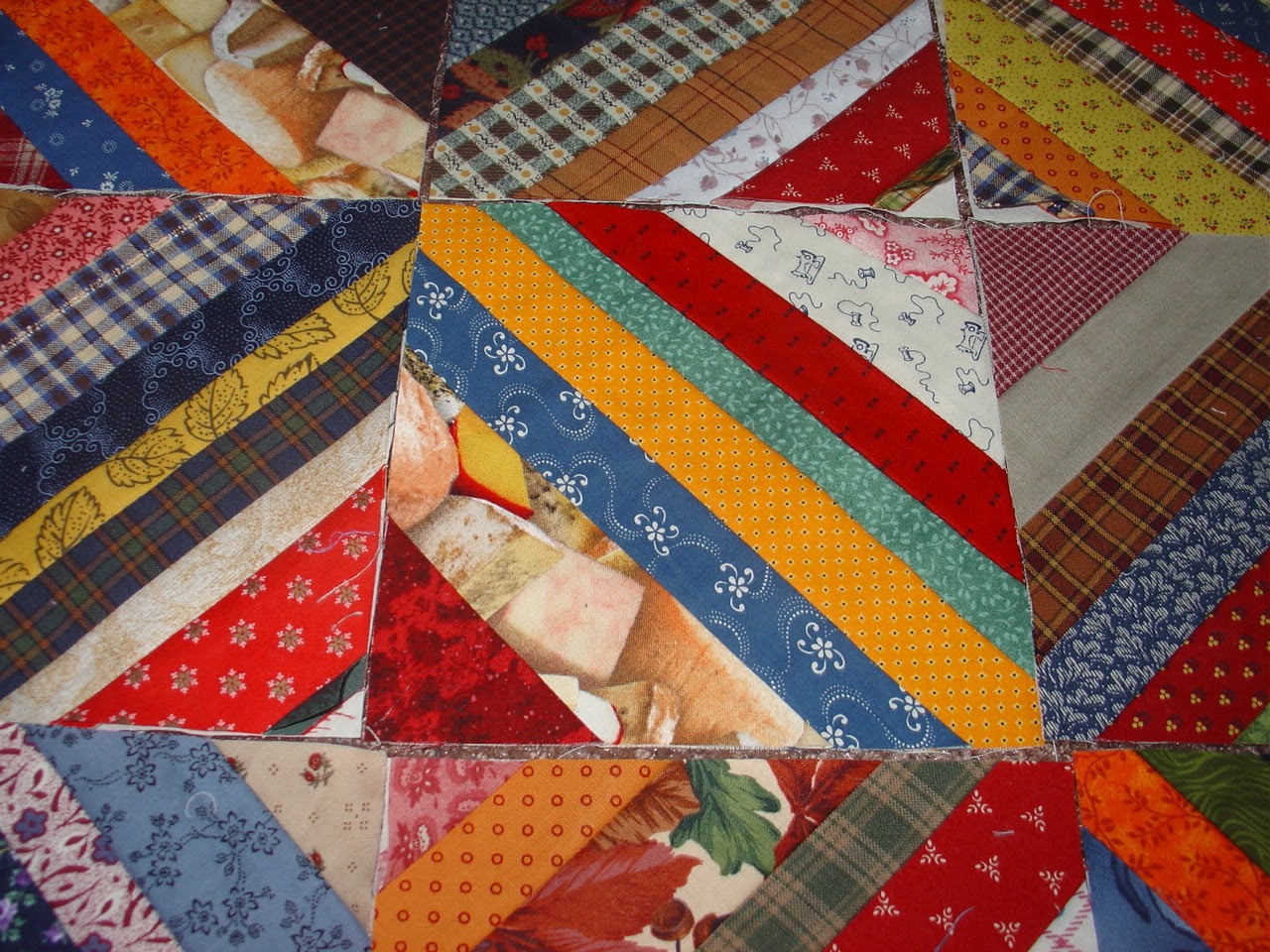
This is what I've been doing with the strings.  I'm making 6.5 in. blocks, and I'm planning to set them side by side.    I was going to use narrow strips between them, but I like this better.

I'm using my trusty Singer model 15 treadle.  I work on 3 blocks at a time, so I can leave one in the machine and take two to the ironing board.  I press after each strip is added.  Once the blocks have a few strips on them, I can add strips first to one side and then to the other side before I have to press.

My favorite part for each block (aside from choosing the strips) is when I get the foundation filled up and it's time to trim it.

I lay it wrong side up, so I can see the edges better, and then I trim with the rotary cutter.

There, all done! 

You might have noticed that my foundations are cloth, rather than the usual paper.  I do that for two reasons.  The first reason is laziness--I just don't like to spend all that time ripping the paper off when I'm done.  Cloth foundations stay in the quilt.  The second reason is more recycling--see below.

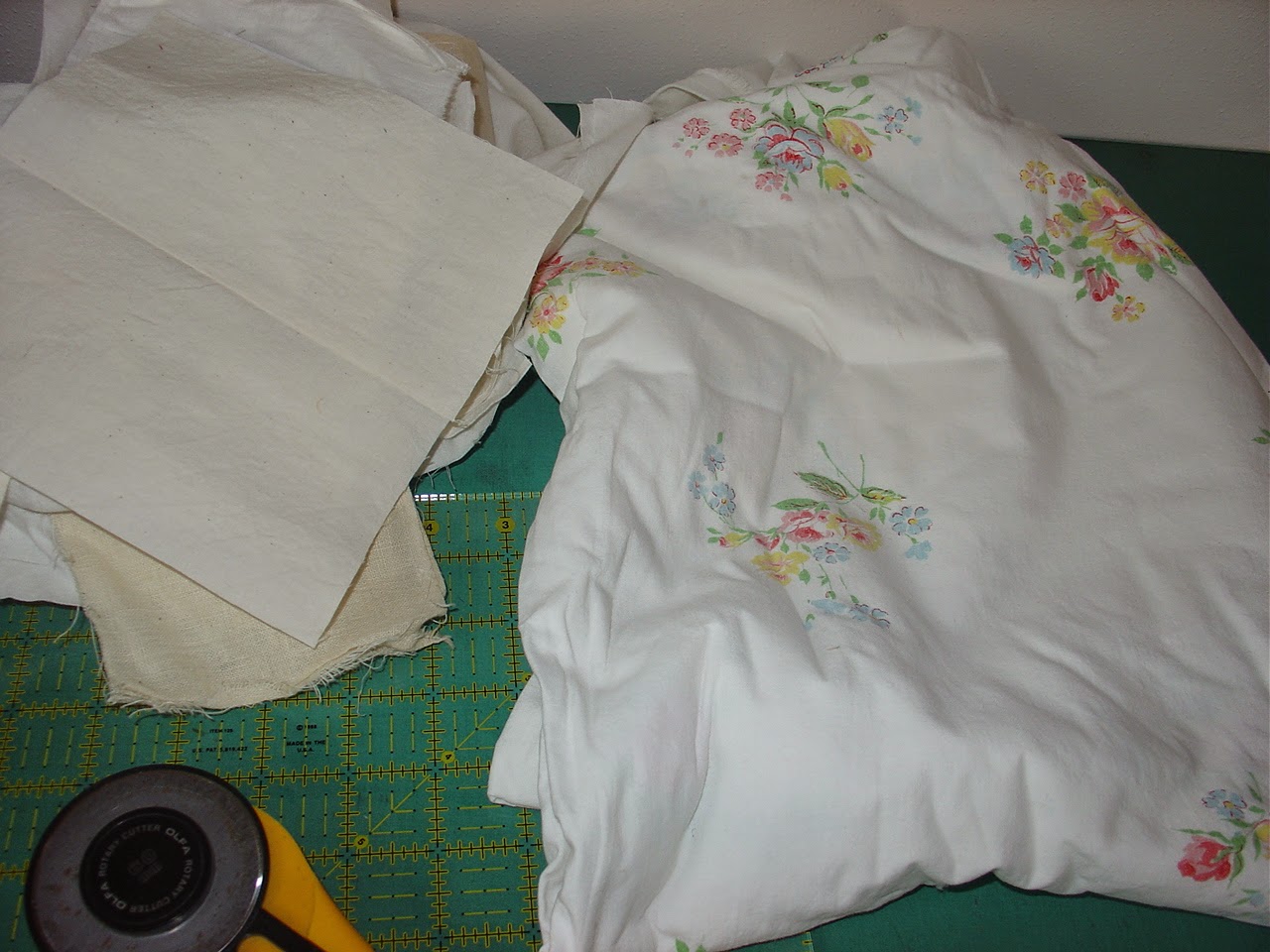
I buy lots of fabric at flea markets, antique stores, etc.  Sometimes I buy a box with some good stuff mixed in with some less than good stuff.  Foundations are something I can make with that less than stellar fabric.  A lot of the foundations for this quilt are from a large piece of very loosely woven muslin that I would NEVER use on the top of a quilt.  The pile above is poor quality muslin (on the left) and most of an old cotton sheet (on the right).  All this stuff gets washed before it goes into the quilt.

I piece the foundations if necessary to make them large enough.  I cut them 7 in. square, and then square them up to 6.5 in. when I trim the blocks.


Before I started, I decided on the type of colors I wanted for this quilt.  A while back I made a string baby quilt out of bright scraps.   For this quilt, I'm using more of a fall color scheme, with lots of browns and greens, perked up with reds, yellows, blues, and little bit of orange.  Most of the orange fabrics come from scraps left from the Celtic Solstice mystery quilt led by Bonnie Hunter last year.  Most of the plaids were given to me by a friend (thanks, Debbie!)  I don't use a lot of light fabrics, but I do sprinkle them in here and there.

What happens when I run out of fall colors in the bushel basket?  I go shopping in my scrap bins!
These are my 2 in. scrap strips.  If the blocks need a little more yellow or red, etc., I pull some out of here.  By mixing in strips from the bins, I'm adding more variety.
I don't go any bigger than 2 in. wide, mainly because I like the way the skinnier strips look.
These are the 1.5 in. wide strips.  Most of my fabric scraps are reproductions, because I've made so many reproduction quilts.  For this quilt, I'm using the repros but also anything else that works color wise.

For some reason, there seems to be a food theme happening on lots of the blocks.  (Did you notice the cheese fabric in the other pictures?)

Thinking about string quilts made me want to look at my antique examples again.  I really love string quilts, and I have collected some good ones.

Isn't this a sweet top?  I bought this from my friend Joey last fall.

There are some pretty big chunks being used in these diamonds.

Here's the back.  You can see that the diamonds are machine pieced on cloth foundations.

Here's another 8 pointed string star.  I found this one in an antique store in Indiana.  The fabrics in this one date it to c. 1910.

I just love the reds and blues of this time period.

Here's the back--cloth foundations again, probably old clothes.

I bought this tattered old top in Kentucky, the first time I went to the big quilt show in Paducah.  The block is often called Rocky Road to Kansas.

This one was pieced on newspaper foundations.  Tiny bits of the paper are still sewn in the seams.  This one was sewn by hand.

Next time, I show some more foundation pieced quilts and blocks from my collection.  If you'd like further instruction on making a string quilt, I suggest reading Bonnie Hunter's String Quilting Primer.  You can get there by clicking on the link below.

String Quilting Primer (by Bonnie Hunter)

Happy quilting (and recycling)!